


China Customs Adds 72-Hour UN R152 Filing Rule
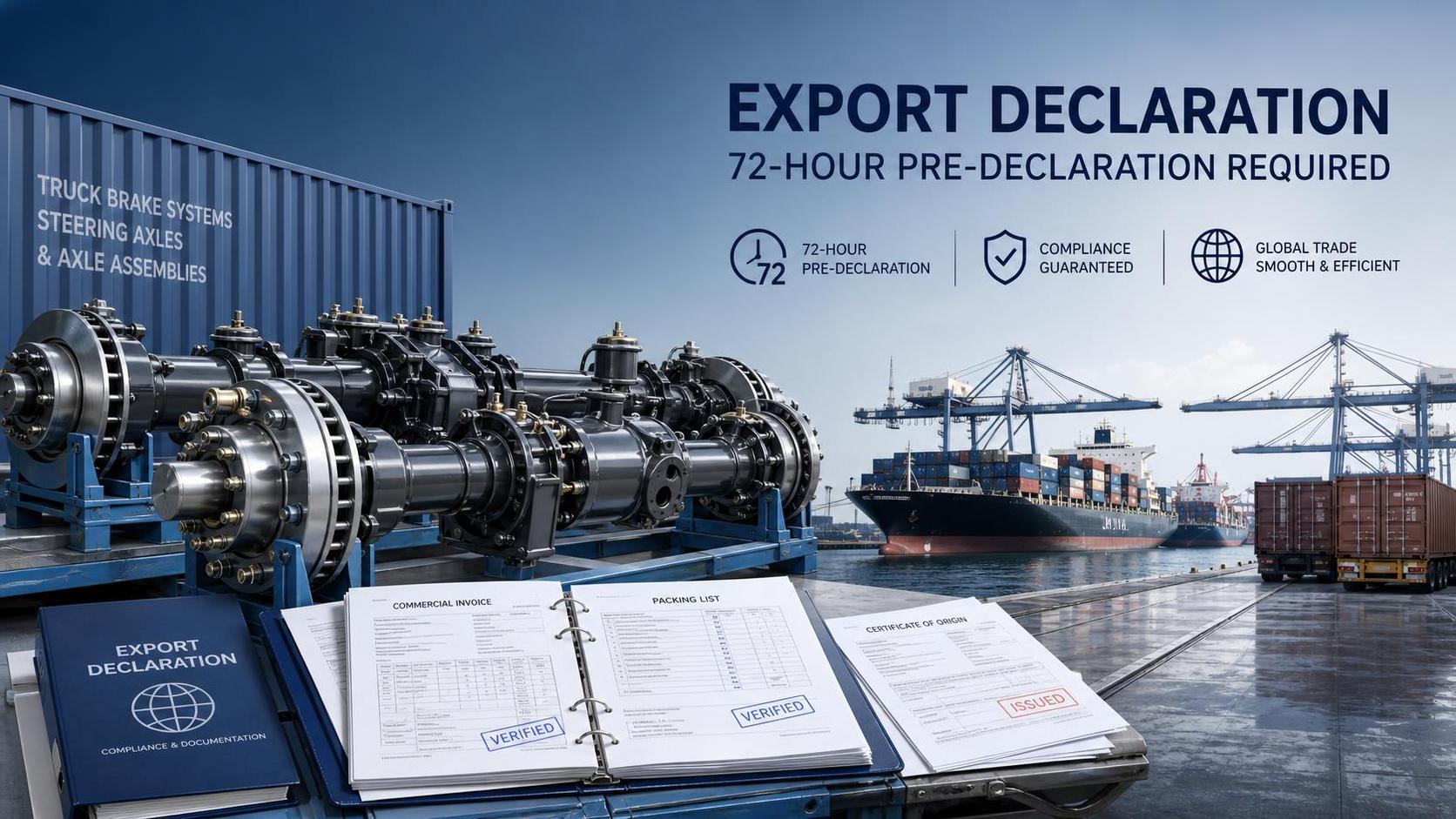
On August 6, 2026, China Customs introduced a new export declaration requirement at major ports including Qingdao, Tianjin, and Shanghai for heavy truck components shipped to the EU. For products such as braking systems, steering axles, and axle assemblies, exporters must upload a UN R152 type-approval certificate and declaration of conformity through the Single Window at least 72 hours before shipment. This is worth close industry attention because the change reaches beyond customs paperwork and directly affects export scheduling, importer clearance timing, and inventory planning, especially where delivery models depend on tight replenishment cycles.
The rule change now built into export filing
According to the provided event summary, the new requirement took effect on August 6, 2026. It applies at major Chinese ports including Qingdao, Tianjin, and Shanghai and covers heavy truck parts exported to the EU, including braking systems, steering axles, and axle assemblies.
Under the new process, companies must submit a UN R152 type-approval certificate together with a declaration of conformity through the Single Window 72 hours in advance. Shipments that are not pre-filed as required may face inspection-related delays or be rejected from filing.
The provided information also states that the measure directly affects customs clearance timing for overseas importers and inventory planning, with particular pressure on European distributors that rely on just-in-time delivery.
Where the pressure is likely to appear first
Export operations will need earlier document readiness
Exporters are the first group affected because the filing requirement is tied to the shipment timeline before goods move. The practical impact is concentrated in document collection, internal review, and handoff into customs filing. What deserves closer attention is whether the UN R152 certificate and declaration of conformity are available early enough to support a 72-hour lead time rather than being assembled close to dispatch.
Manufacturing and shipping coordination become more rigid
For manufacturers of covered heavy truck components, the rule can affect the point where production release connects with export booking. If product completion, packaging, and shipment preparation are still managed on compressed timelines, the new pre-submission window may create friction between factory readiness and export compliance. From an industry perspective, this makes document timing and shipment timing more closely linked than before.
EU importers and distributors face downstream timing risk
Overseas importers, especially distributors serving the European market, may feel the impact through slower or less predictable inbound timing when pre-declaration is incomplete or late. The business effect is not limited to customs procedure on the China side; it can also influence receiving plans, replenishment sequencing, and inventory buffers on the destination side. This matters most where buyers are operating with tight stock coverage or just-in-time delivery expectations.
Supply chain service providers may see more compliance-sensitive handling
Freight forwarders, customs service providers, and other logistics coordinators may need to pay closer attention to whether the required certification package has been prepared before cargo cutoff. Analysis shows that the key change for these participants is procedural: shipment planning can no longer rely only on transport and port timing, because compliance document readiness now has a fixed advance submission requirement tied to export processing.
What companies should watch in daily execution
Check whether covered products are mapped correctly
Companies trading in heavy truck parts should first verify whether the products they ship to the EU fall within the categories described in the event summary, including braking systems, steering axles, and axle assemblies. This is a basic but important control point because filing obligations begin with product scope identification.
Review the readiness of UN R152 compliance files
The immediate compliance issue is not only whether a certificate exists, but whether the UN R152 type-approval certificate and declaration of conformity can be prepared and uploaded through the required channel within the 72-hour window. Observably, firms with fragmented document ownership across engineering, quality, and export teams may need tighter internal coordination.
Reassess delivery promises tied to short lead times
Businesses serving EU customers under short replenishment cycles should examine whether current shipment promises leave enough time for pre-declaration. The provided information does not define broader execution details, so it would be premature to assume a uniform operational outcome across all cargo flows. Even so, delivery planning, booking cutoffs, and customer communication are likely areas requiring attention.
Track further wording and market-side implementation signals
Because the input does not provide detailed enforcement guidance beyond the filing requirement and the risk of delay or rejection, companies should continue watching for any additional official wording, filing interpretation, customer-side document requests, and procurement document changes linked to this rule. This is particularly relevant for suppliers whose orders are tied to strict delivery windows or formal compliance commitments.
Why this reads as an execution signal, not just a headline
Analysis shows that this development is best understood as a rule now entering operational practice rather than a distant policy discussion. The requirement has a clear effective date, a defined submission window, named filing channel, and stated consequences for non-compliance. At the same time, it is still too early to draw broad conclusions about how uniformly the rule will be enforced across different shipments and business arrangements based only on the provided information.
From an industry perspective, the more important signal is that certification evidence is being pulled forward into the export declaration stage for covered goods. That shifts attention from downstream problem-solving to upstream filing readiness, which is why exporters, logistics teams, and EU buyers all have reason to watch the implementation closely.
A practical reading of the change
The immediate significance of this measure lies in timing discipline. It does not merely add another document to the trade file; it changes when that document must be available and how early compliance must be built into shipment planning. For affected heavy truck component trade into the EU, it is more appropriate to understand this as an implemented procedural change with direct operational consequences, while still leaving room to observe how detailed enforcement and market response develop in practice.
Basis of this article and what still needs verification
This article is based on the user-provided news title, event date, and event summary. For this type of development, commonly relevant source categories would include official announcements, customs or trade authority releases, regulator communications, industry association notices, standards-related documents, and reporting from authoritative trade media.
No specific official source link was provided in the input, so the original source text and any later official clarifications still need to be verified on an ongoing basis. Further observation is also needed on implementation details, certification interpretation, filing practice, procurement document changes, market feedback, and how affected companies execute the new requirement in day-to-day trade operations.
Related Posts
CONTACT US

First class quality service and professional after-sales team.
Get in Touch
*We respect your confidentiality and all information are protected.