


China Customs Starts 72-Hour Export Data Rule
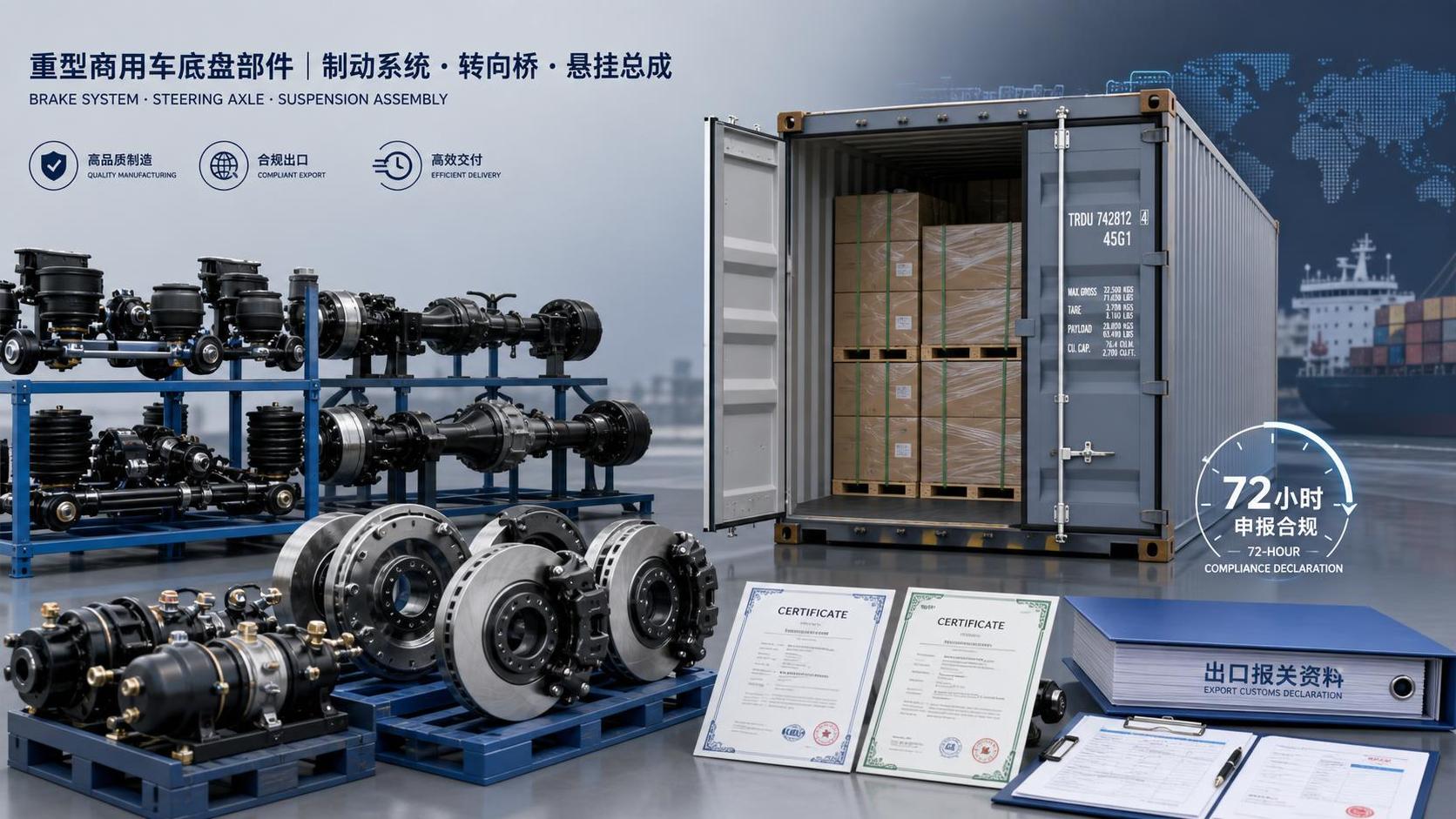
On July 23, 2026, China Customs began operating a new export declaration system, ECS 2.1, with a more structured compliance requirement for heavy commercial vehicle parts shipped to the EU, the US, the Middle East, and Southeast Asia. For exporters handling products such as braking systems, steering axles, and suspension assemblies, the change is notable because certification data tied to ECE R140, SAE J1980, and GCC must now be filed 72 hours before shipment, creating a direct checkpoint that can affect customs processing, delivery timing, and downstream inventory planning.
What the new filing requirement changes
The confirmed change is that, from July 23, 2026, the General Administration of Customs of China has put the new ECS 2.1 export declaration system into formal use. Under this system, heavy commercial vehicle parts exported to the EU, the US, the Middle East, and Southeast Asia must complete structured submission of certification information related to ECE R140, SAE J1980, and GCC no later than 72 hours before shipment.
The scope described in the event summary includes heavy commercial vehicle components such as braking systems, steering axles, and suspension assemblies. The same summary also states that declarations failing to meet the requirement will trigger automatic rejection and port detention. It further indicates that the resulting disruption can affect customs clearance timing for overseas importers and their inventory arrangements.
Where the pressure is likely to appear first
Export operations and shipping coordination
From an industry perspective, exporters are likely to feel the impact first because the rule moves compliance data preparation further upstream in the shipment process. The practical issue is not only whether certification exists, but whether the relevant information can be submitted in the structured form required by ECS 2.1 before the 72-hour deadline. That makes export documentation, booking schedules, and internal release timing more tightly linked than before.
Manufacturers of regulated heavy-duty components
For manufacturers of braking systems, steering axles, suspension assemblies, and similar parts, the change can affect the handoff between technical compliance records and trade documentation. Analysis shows that the operational risk sits in the interface between product certification evidence and export filing readiness. Where supporting records are incomplete, inconsistent, or not organized for structured declaration, shipment preparation may slow even before cargo reaches the port.
Importers and buyers managing delivery windows
Overseas importers and procurement teams may not be the filing party in China, but they are exposed to the timing effect. The event summary already confirms the connection to customs clearance efficiency and inventory planning. Observably, any declaration rejection or port hold can push uncertainty into receiving schedules, replenishment timing, and short-term stock planning, especially where procurement depends on fixed shipment windows.
Compliance and certification support functions
Certification-related service providers and internal compliance teams may also face a more immediate workload shift. What deserves closer attention is the need to align certification information with a customs submission format rather than treating certification as a separate archive item. Even without additional execution details, the rule clearly raises the importance of document readiness, traceable technical records, and timely coordination between compliance and export teams.
What companies should watch in daily execution
Readiness of certification records before shipment booking
Analysis shows that companies shipping affected parts should pay close attention to whether ECE R140, SAE J1980, and GCC information is complete and ready before shipment milestones are locked in. The event summary confirms the deadline, but it does not provide further filing detail, so the key issue for now is preparation discipline rather than assumptions about exact system behavior beyond the stated requirement.
Consistency between technical files and customs declarations
Another practical point is the consistency of product-level technical and certification records with the data entered into ECS 2.1. Because the requirement is for structured submission, firms should closely monitor how internal product data, testing records, and declaration inputs are matched. This is not yet evidence of a broader policy shift beyond the stated filing rule, but it is a clear execution point that can affect whether a shipment proceeds smoothly.
Delivery planning for destination markets within scope
Companies serving the EU, the US, the Middle East, and Southeast Asia should also review how the 72-hour lead time affects dispatch planning. What deserves closer attention is whether contract delivery dates, buffer stock assumptions, and dispatch sequencing still match the longer compliance preparation window now built into export processing for covered components.
Supplier qualification and document handover
For businesses that source from multiple factories or component suppliers, document control may become a larger issue than production itself. Observably, suppliers that cannot hand over usable certification data in time may create shipment risk for the exporter of record. This makes supplier-side compliance readiness and document transfer discipline a practical area to monitor, even though the event summary does not specify any formal new supplier rule.
Why this looks like an execution signal, not just a system update
Analysis shows that this development is better understood as a live compliance checkpoint rather than a routine IT upgrade. The requirement combines three elements that matter operationally: a named system launch, a defined pre-shipment filing window, and a stated consequence of non-compliant declarations through automatic rejection and port detention. That combination suggests an immediate execution signal for affected trade flows.
At the same time, it is also appropriate to treat part of the picture as still developing. The event summary does not provide detailed guidance on filing interpretation, verification practices, or how consistently the requirement may be applied across different business scenarios. For that reason, continued observation is warranted around implementation language, market feedback, and any later clarification affecting certification data handling.
How the market is likely to read this change for now
From an industry perspective, the most balanced reading is that the rule has already crossed from policy notice into operational requirement. It directly links export clearance for certain heavy commercial vehicle parts to earlier, structured compliance submission, which means the impact is most immediate in documentation flow, shipment timing, and importer planning.
It is more appropriate to understand this as a rule now in force with execution details still worth tracking, rather than as a distant policy direction or a fully settled practice with no remaining uncertainty. Businesses affected by the covered markets and product categories have a current reason to review filing readiness, but the broader market effect still depends on how the requirement is applied in day-to-day trade operations.
Basis of this article and what still needs verification
This article is based on the user-provided news title, event date, and event summary. For developments of this type, relevant source categories commonly include official notices, releases from customs or trade authorities, regulatory updates, industry association communications, standards body materials, and reporting by established trade or industrial media. A specific official source link was not provided in the input, so the exact original publication and any subsequent explanatory documents still need to be verified on an ongoing basis.
Further observation should focus on whether additional implementation detail emerges around filing interpretation, certification data scope, execution standards, tender or procurement document changes, industry feedback, and how companies adapt their export documentation and delivery processes in response.
Related Posts
CONTACT US

First class quality service and professional after-sales team.
Get in Touch
*We respect your confidentiality and all information are protected.