


EU Requires UN ECE R124 for Heavy Truck Parts Imports
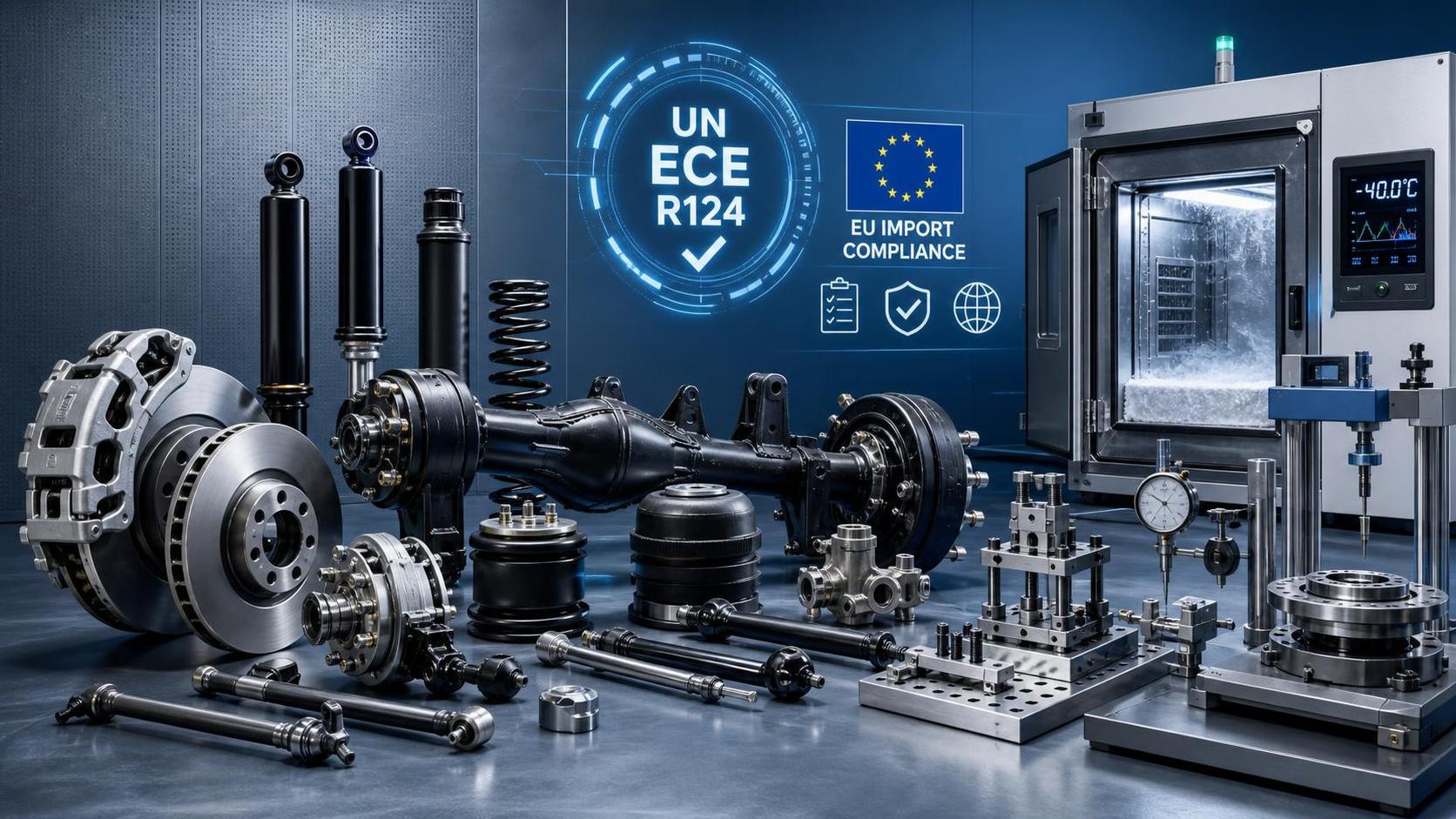
From August 1, 2026, the European Union has begun enforcing mandatory UN ECE Regulation No. 124 certification for newly imported heavy commercial vehicle brake system, suspension, and axle components. For companies involved in exports to Europe, distribution, sourcing, and cross-border delivery, this is not just a standards update. It directly affects customs clearance, compliance eligibility, lead times, and the cost of adapting products to new technical requirements.
What Has Taken Effect on August 1, 2026
The confirmed change is that the EU has formally implemented a mandatory certification requirement under UN ECE Regulation No. 124 for all newly imported parts in the categories of heavy commercial vehicle braking systems, suspension, and axles.
According to the provided information, this regulation replaces certain provisions previously covered under the E-mark framework. It also introduces two additional verification areas: dynamic durability testing and low-temperature performance validation.
The stated enforcement consequence is clear: products that do not obtain the required certification will be refused customs clearance. The change is described as having a direct impact on Chinese suppliers shipping such products to the European market.
Where the Pressure Will Be Felt First
Export shipments face an immediate compliance gate
Direct trading companies and exporters are likely to feel the impact first because the rule is tied to import acceptance. If certification is missing, the issue is no longer limited to technical review or customer preference; it becomes a customs clearance barrier. What deserves closer attention is whether current export pipelines still include products relying on earlier E-mark-related assumptions.
Manufacturers will need to address testing-related adaptation
For processing and manufacturing companies, the main pressure point is product conformity under the newly specified test items. Analysis shows that the addition of dynamic durability testing and low-temperature performance validation may affect technical preparation, internal validation work, and the timing of production release for Europe-bound parts.
Distributors in overseas channels must reassess market access risk
Overseas distributors and channel operators are also exposed because their market access depends on whether imported products can legally enter the EU. From an industry perspective, the issue is not only product availability but also whether supplier qualification and incoming compliance documents remain sufficient under the new rule.
Procurement and delivery planning may become less predictable
Procurement teams, supply chain coordinators, and service providers may see the impact in purchasing cycles and delivery scheduling. The provided information explicitly links the regulation change to procurement lead times and technical adaptation costs, which means contract timing, replenishment planning, and customer delivery commitments may all require closer review.
What Companies Should Track Now
Confirm whether affected product lines fall within the new import scope
Companies should first identify whether their brake system, suspension, or axle parts for heavy commercial vehicles are part of new imports into the EU after August 1, 2026. The practical issue is scope confirmation, because the commercial risk begins once a shipment enters the import process without the required certification basis.
Separate legacy approval assumptions from current certification needs
The regulation is described as replacing certain E-mark provisions. Analysis shows that firms should not assume earlier approval logic remains fully sufficient for ongoing EU business. What deserves closer attention is the difference between historical compliance status and the documentation now required for customs acceptance.
Prepare for added testing and longer technical coordination
Because dynamic durability and low-temperature performance checks have been added, businesses should pay attention to how these requirements affect testing schedules, product documentation, and technical communication with customers or distributors. This is especially relevant where order commitments were set under earlier compliance expectations.
Strengthen shipment documents and customer communication
For exporters and distributors, supplier qualification files, certification documents, and shipment-related compliance materials will likely become more important in day-to-day execution. Observably, customer communication should also shift from general compliance claims to more specific confirmation of certification readiness and delivery timing.
Why This Looks Like More Than a Routine Update
Analysis shows that this development should be understood as an operational compliance change with immediate trade consequences, not merely as a technical standards notice. The reason is straightforward: the stated penalty is refusal of customs clearance, which moves the issue directly into transaction execution and delivery risk.
It is more appropriate to understand this as both a short-term disruption point and a longer-term regulatory signal. In the short term, it can affect active export deliveries and distributor access. In the longer term, it suggests that technical verification requirements for heavy commercial vehicle parts entering the EU may be becoming more specific and more demanding in practice.
At the same time, this remains a development that still requires continued observation in its practical application. The confirmed facts establish the rule, the scope, and the customs consequence, but companies will still need to monitor how the requirement is interpreted and managed in actual trade workflows.
How the Market May Need to Read This Change
The immediate significance of this regulation is not limited to certification paperwork. It connects product compliance, customs entry, distributor eligibility, procurement timing, and technical adaptation into a single operational issue. For companies supplying the EU heavy commercial vehicle parts market, the change is best treated as a concrete compliance threshold already in force.
A balanced reading is that this is neither a minor procedural adjustment nor a basis for exaggerated market conclusions. It is more appropriate to understand the development as a clear regulatory tightening with direct execution impact, while leaving room for continued observation around implementation details and downstream business adjustments.
Basis of This Article and Ongoing Verification
This article is based on the user-provided news title, event date, and event summary concerning the EU's August 1, 2026 enforcement of mandatory UN ECE Regulation No. 124 certification for newly imported heavy commercial vehicle brake system, suspension, and axle parts.
For this type of industry update, commonly relevant source categories may include official notices, company announcements, industry association updates, authoritative media reporting, and standard-setting organization documents. A specific official source link was not provided in the input, so the exact source chain still requires ongoing verification.
Further attention should remain on any subsequent official wording, implementation clarifications, and practical documentation or customs-related interpretations that may affect execution for exporters, distributors, and procurement teams.
Related Posts
CONTACT US

First class quality service and professional after-sales team.
Get in Touch
*We respect your confidentiality and all information are protected.