


EU Battery Carbon Footprint Label Becomes Mandatory for Industrial Battery Exports on Aug. 18
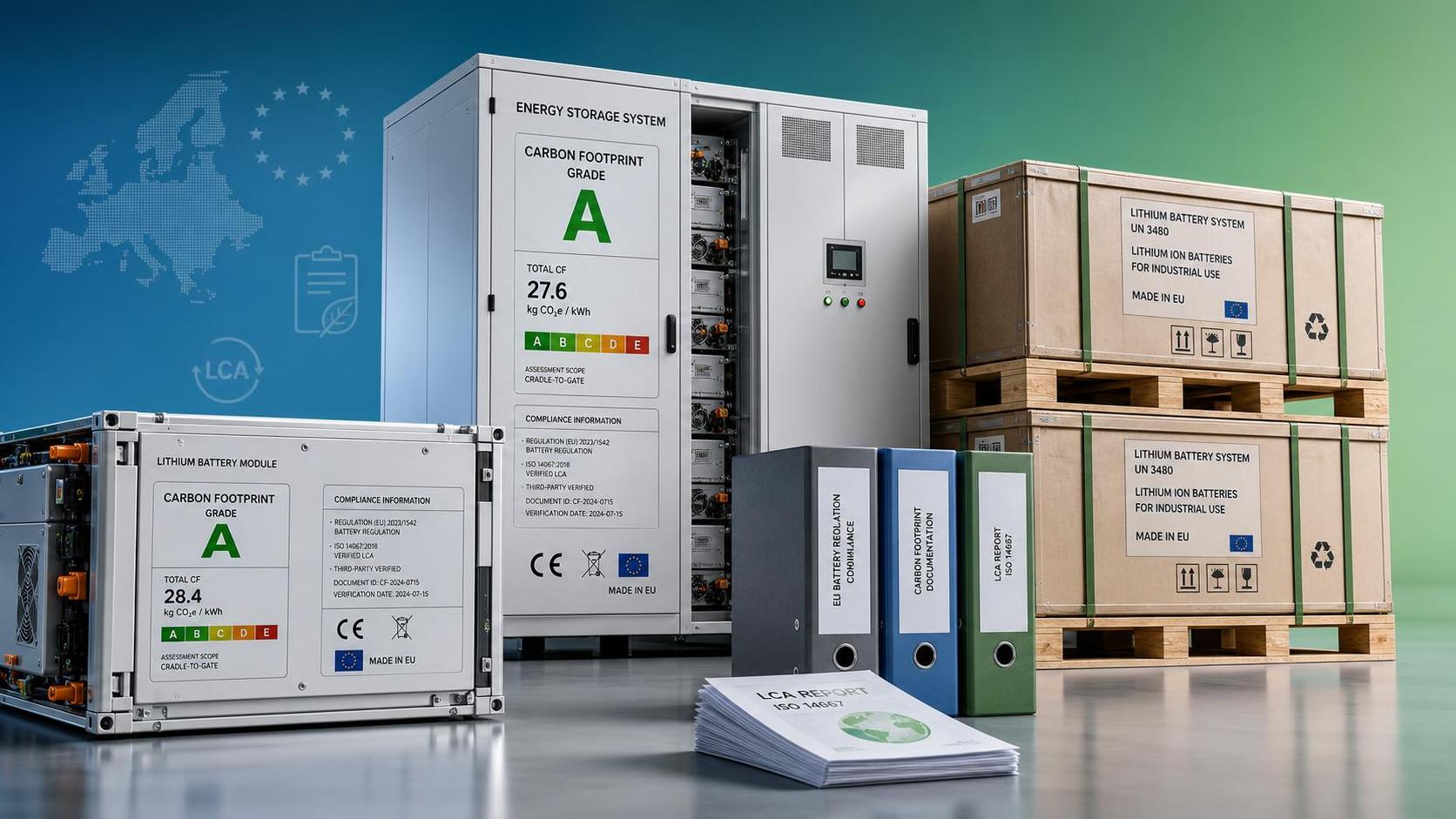
From August 18, 2026, the EU Battery and Waste Battery Regulation ((EU)2023/1542) formally requires rechargeable industrial batteries with a capacity above 2kWh to carry a carbon footprint performance class label. Based on the information provided for this update, the label must be generated from certified life cycle assessment (LCA) data, and products that do not meet the requirement will not be allowed to enter the EU market.
For exporters of industrial batteries and related equipment, this is not a marginal documentation change. The rule directly affects shipments tied to industrial battery applications, including power battery systems for electric heavy trucks and energy storage power modules mentioned in the event summary. In practice, the compliance threshold is moving beyond product performance and safety into verified carbon data management.
What the requirement changes
The immediate shift is that carbon footprint information becomes a market access condition for the covered battery category. That raises the compliance burden not only for battery manufacturers, but also for upstream and downstream participants involved in export transactions. Where product entry once depended mainly on technical conformity and commercial readiness, companies now also need a certified LCA basis strong enough to support the required label.
This matters because the label is not described here as a voluntary disclosure tool. It is presented as a mandatory requirement linked to EU market access. That distinction is likely to reshape how exporters prepare product files, how importers review supplier qualifications, and how distributors assess the readiness of inventory intended for the EU.
Why importers and distributors are also under pressure
The event summary highlights that importers and distributors need to verify supplier carbon data compliance in advance and review progress on digital battery passport preparation. That point suggests the impact will extend beyond manufacturing plants to the broader commercial chain. Companies handling EU-bound products may need to confirm earlier in the transaction process whether suppliers can provide compliant carbon data and whether supporting digital documentation is sufficiently prepared.
From a business operations perspective, this could make supplier screening more stringent. Export-oriented firms that can deliver certified LCA data and demonstrate readiness for related documentation may be in a stronger position in negotiations. Those that are still building internal reporting, verification, or traceability processes could face delays even before a shipment reaches customs or distribution channels.
A signal for the industrial battery supply chain
Based on the information available, the new requirement signals that carbon disclosure is becoming more tightly embedded in battery trade rules rather than remaining a separate sustainability narrative. For companies serving the EU market, compliance capability may increasingly sit alongside cost, delivery, and technical performance as a core export condition.
In the near term, the first pressure point may be internal readiness: whether companies have certified LCA support, whether product-level data can be translated into a valid label, and whether cross-border partners are aligned on documentation standards. The next point to watch is execution consistency. Even if the regulation is clear in principle, the commercial impact will depend on how efficiently companies can integrate carbon data verification into everyday export workflows.
This article is based on the title, date, and event summary provided in this brief. For follow-up tracking, the most relevant public information will likely come from regulatory announcements, official guidance documents, company disclosures related to EU export compliance, and other authoritative industry updates tied to battery labeling and digital passport implementation.
Related Posts
CONTACT US

First class quality service and professional after-sales team.
Get in Touch
*We respect your confidentiality and all information are protected.